> ## Documentation Index
> Fetch the complete documentation index at: https://comfyui-mcp.artokun.io/docs/llms.txt
> Use this file to discover all available pages before exploring further.
# From bug report to published release, autonomously
> How comfyui-mcp turns a bug report into a shipped fix: an MCP intake tool, a Cloudflare Worker that triages with an AI agent, a swarm of coding agents, an adversarial merge gate, and a tagged release.
*by [artokun](https://github.com/artokun) · August 19, 2026 · autopilot · Cloudflare · agents*
Header made with the thing this post is about — MiniMax H3 text-to-video, running locally on one
4090, from a prompt and no input image. It plays forward and then backward, so the spill spreads
and is hauled back in, forever. Everything in frame was asked for: the lettering on the arm, the
graffiti, and the person outside pouring more slop in through the window — a machine tidying
while a human keeps topping up the mess, which is the joke and also roughly the job. Written as
an homage to Sun Yuan and Peng Yu's
[*Can't Help Myself*](https://www.guggenheim.org/artwork/34812), a caged robot arm that spends
its life gathering its own leak back toward itself. Theirs is a great deal sadder.
Included because it is the evidence for the paragraph above, and because the interesting part is
not the adjectives — it is how much of the result comes from stating the **mechanic** and the
**exclusions**. An earlier attempt asked the arm to "drag the spill inward" and got a sideways
sweep; spelling out reach-out-plant-retract, and then saying what it must never do, produced the
hauling motion. Same for text: name exactly which strings exist, say where each one goes, and
forbid the rest.
```text theme={null}
In the spirit of the contemporary art installation "Can't Help Myself" by Sun Yuan & Peng Yu — a
single caged industrial robot arm endlessly gathering a spreading pool of viscous fluid back toward
itself, futile and tireless.
A bright white minimalist gallery room, pale concrete floor, one large window of soft overcast
daylight. A single orange industrial KUKA robot arm is bolted to a low steel base in the centre of
the room, fitted with a wide flat squeegee blade. Large clean black letters on the side of the
arm's main housing read "COMFYUI MCP". On the left wall, spray-painted graffiti reads "100%
AUTOMATED". The right wall is bare white concrete, no artwork, no writing. Thick glossy
ComfyUI-blue slime, a vivid electric cyan-blue, oozes continuously out from underneath the base and
creeps outward across the concrete.
Timeline:
[0s-2s] Static wide shot. Blue slime seeps steadily out from under the base, spreading outward
across the pale floor. Through the window, a person wearing a white VR headset walks up to the
glass carrying a bucket of the same blue slime.
[2s-4s] The person tips the bucket and pours blue slime in through the open window; it splatters
onto the concrete and joins the spreading pool. They stand there watching, headset still on.
[4s-7s] The arm EXTENDS out to full reach, lowering the squeegee flat onto the concrete at the
outer edge of the spill. Then the elbow FOLDS and the whole arm RETRACTS, pulling the blade back in
toward its own base and hauling a rolling bank of slime with it, leaving a clean wet streak of bare
concrete behind. The slime piles up against the base.
[7s-9s] The arm extends out again at a different angle, plants the blade at the outer edge, and
RETRACTS a second time, hauling more slime back to the heap at its base.
[9s-10s] The arm folds up to its upright rest pose over the base, while fresh slime is already
welling out from underneath and starting to spread again.
The arm's job is to HAUL slime toward itself. Every working motion is a reach-out-then-pull-back,
like a person raking leaves toward their feet — the blade always ends closer to the base than it
started. It never pushes slime away, and it never sweeps the blade sideways in an arc around
itself.
Locked-off static camera, no camera movement, no cuts, no zoom, no push-in. Cinematic
architectural photography, muted white and grey palette against vivid ComfyUI blue, glossy wet
reflections on the concrete, soft daylight shadows. Methodical, calm, unhurried, endlessly tidy.
Audio: quiet room tone, low mechanical servo hum, wet squelching as the squeegee hauls slime across
concrete, a heavy wet splat as the bucket is poured, no music.
Exactly two pieces of text appear and nothing else: "COMFYUI MCP" on the robot arm, and "100%
AUTOMATED" on the left wall. Both large, sharp, correctly spelled English, cleanly legible and
stable throughout. No logos, no emblems, no murals, no signage, no subtitles, no watermarks, no
other lettering.
```
Most of the fixes in [comfyui-mcp](https://github.com/artokun/comfyui-mcp) are filed, triaged,
written, reviewed, tested and released without anyone opening a text editor. Not because the
agents are trusted — precisely because they aren't. Every stage in this pipeline exists to catch
the stage before it.
Here's the whole thing, then each piece in detail.
```mermaid theme={null}
flowchart TD
A["Agent hits a defect
(or a user reports one)"] --> B["report_issue
MCP tool"]
B --> C["Cloudflare Worker
intake + AI triage"]
C -->|new / related| D["GitHub issue
severity + labels"]
C -->|duplicate| E["Comment on the
existing issue"]
C -->|already fixed| F["advised_upgrade
no issue written"]
D --> G["Autopilot swarm
one agent per issue"]
G --> H{"Terminal state"}
H -->|CLOSED-NO-CODE| I["Closed with evidence"]
H -->|PARKED| J["Labelled, left alone"]
H -->|fix written| K["Merge gate
adversarial review"]
K -->|NO-SHIP| G
K -->|SHIP| L["CI: build +
~10k tests"]
L --> M["Merge to protected main"]
M --> N["Tag → npm publish"]
M --> O["pyproject bump →
Comfy Registry"]
```
## Stage 1 — intake, and the honesty problem
Reports arrive through an MCP tool, `report_issue`, which any agent driving ComfyUI can call. The
governing instruction is **fix-then-file**: when an agent hits a defect in our own code it patches
it locally so the user is unblocked, *then* files the report with the diff attached. Reports arrive
as near-PRs rather than tickets.
The bias is deliberately toward over-reporting. You do not need to be blocked, and it does not need
to be fatal — a workaround you had to invent is itself the signal. Server-side dedup makes a
duplicate a no-op, so under-reporting is the expensive failure mode.
Two things in a report are not written by the reporting model, because a model is a poor witness
about itself:
* **Versions** are read from the running process, not asked for. The version named first is the one
*executing*, which is not always the one installed on disk — an upgrade that lands while the
orchestrator is up would otherwise pin every issue to code nobody ran.
* **Which model is filing** is stamped by the orchestrator from the panel's provider/model
selection. Ask a model to name itself and it guesses; the agent's environment block never carried
the model at all. So the orchestrator publishes it and the tool reads it back:
```
Filed from the ComfyUI panel by **ollama** · model `gemma3:4b` — stamped by comfyui-mcp
from the panel's provider/model selection, not self-reported.
```
That matters more than it sounds. The panel can be driven by a frontier model or a local 4B, and
report quality tracks that choice closely. Without the stamp, a thin report from a small local
model is indistinguishable from a thin report from a large hosted one.
## Stage 2 — the Cloudflare Worker that triages
Intake is a Cloudflare Worker. Each report gets its own Durable Object running an agentic loop
(Agents SDK → GitHub's remote MCP → a reasoning model), so triage is a real investigation rather
than a template.
```mermaid theme={null}
stateDiagram-v2
[*] --> PENDING: POST /report
PENDING --> INVESTIGATING: search open + closed issues
INVESTIGATING --> CLOSED: exactly ONE write
CLOSED --> [*]
note right of PENDING
Returns instantly with a job id
and a mechanical version check
end note
note right of INVESTIGATING
Semantic dedup, version match,
severity assessment P0-P3
end note
note right of CLOSED
create | comment | reopen
or advised_upgrade (zero writes)
end note
```
The submit returns immediately with a job id and a **mechanical** version acknowledgement — a plain
comparison against the latest published versions, computed without the model. The client then polls
until the job closes. The design rules that matter:
* **One write per job.** The agent gets a budget of exactly one triage action — create, comment,
or reopen, and a reopen plus its explanatory comment counts as one. That
budget is reserved *before* the call executes, so a write whose response is lost still counts.
* **Severity is never caller-supplied.** The triage model assesses P0–P3 and the issue is *born*
with the label; a caller-supplied `severity:*` label is stripped at intake so a reporter cannot
spoof a P0.
* **The body is pinned.** A created issue carries the reporter's body verbatim, not the model's
paraphrase. This is also why the model stamp rides in the body rather than a payload field —
unknown top-level fields are dropped, but the body always survives.
* **The best outcome writes nothing.** If triage matches the report to an issue already fixed in a
version newer than the reporter's, it answers with the fixing PR and a recommendation to upgrade.
No issue is created. The most common real resolution is "you are several versions behind."
* **Idempotency by HMAC.** Every body carries an unforgeable content marker, so a retry after an
uncertain write adopts the existing issue instead of filing a twin.
## Stage 3 — the swarm
Filed issues are picked up by an autopilot: one agent per issue, each in its own git worktree so
they cannot collide. An agent owns its issue until it reaches a **terminal state**, and there are
only three:
```mermaid theme={null}
flowchart LR
I["Issue"] --> Q1{"Already fixed
on main?"}
Q1 -->|yes| C1["CLOSED-NO-CODE
with tag/PR evidence"]
Q1 -->|no| Q2{"In scope
right now?"}
Q2 -->|no| P["PARKED
autopilot:parked label"]
Q2 -->|yes| W["Write the fix"]
W --> G["Merge gate"]
G --> M["MERGED"]
```
The counter-intuitive rule is the important one: **manufacturing a change for an issue that needs
none is the most damaging thing an agent can do here.** On the last backlog sweep, 28 of 34
closures needed no code at all — the report was against an old version, or described a fix that
already existed. So the first task is always "is this already fixed?", answered with
`git tag --contains` against the reporter's stated version, in *both* repos, because the server and
the panel ship separately.
Parked is declared with a label, not prose — closed and merged are the GitHub states themselves.
A supervisor reads labels; a beautifully
argued comment saying "parked" that lacks the label reads as unfinished work and gets resumed
forever.
## Stage 4 — the gate that says no
No fix merges on its author's own judgement. The diff goes to a **separate model in a fresh
session** that has never seen the implementation, is given only the diff, and is told to refute it.
```mermaid theme={null}
flowchart TD
D["Diff"] --> R["Fresh adversarial reviewer
works a fixed taxonomy"]
R --> V{"Verdict"}
V -->|"exit 0 — SHIP"| M["Merge allowed"]
V -->|"exit 1 — NO-SHIP"| F["Fix the findings"]
V -->|"exit 2 — INDETERMINATE"| H["HOLD
never a pass"]
F --> D
H --> D
```
Three exit codes, and the third is the one that earns its keep: a reviewer that ran out of quota,
died mid-run, or produced empty output is **INDETERMINATE**, which holds the merge. Treating
"couldn't check" as "checked and fine" is the failure this contract exists to prevent.
The reviewer works a fixed taxonomy of defect classes. The most productive by far:
1. **Two states collapse.** A check that cannot distinguish the case you care about from one you
don't.
2. **A guard comparing the wrong pair.** Present, correct-looking, and asking about the wrong two
values.
3. **A test that cannot fail.** Green because it manufactures the state production destroys.
That last one is not theoretical. In a single day of work on one feature, three separate tests of
mine were blind by construction — including one that hand-wrote a field into a config file
immediately before calling the function whose own first act is to erase that field. Thirteen
passing tests proved nothing about the bug they were written for.
The gate rounds are not ceremony either. On one small change — a fallback for Windows accounts that
cannot create scheduled tasks — three successive rounds found six P1 defects, and two of them were
introduced by the fixes for the previous round's findings. Every one of them would have hit exactly
the users the feature was written for.
## Stage 5 — evidence, not green checks
A passing suite is necessary and nowhere near sufficient. Two habits do the real work:
**Mutation testing at the call site.** Before believing a test protects a fix, break the fix and
confirm the suite goes red. A test that passes with the code deleted is decoration. This regularly
catches wiring that no test actually reaches — the helper is covered, the *call* to it is not.
**Live verification on real hardware.** Unit tests cannot tell you whether a spawned subprocess
actually receives the environment variable you passed it. So the pipeline runs the built artifact:
a real orchestrator on a real bridge port, driven over the real panel protocol, with a real agent
turn. For releases, the *published tarball* is unpacked and grepped for the symbols that were
supposed to ship — verifying the artifact, not the CI run that produced it.
## Stage 6 — release
Two packages ship on two different mechanisms, and both mainlines are protected.
```mermaid theme={null}
flowchart TD
subgraph npm["comfyui-mcp → npm"]
A1["Bump on release/x.y.z"] --> A2["PR → CI → merge commit"]
A2 --> A3["Tag the MERGED sha"]
A3 --> A4["release.yml publishes"]
end
subgraph reg["comfyui-mcp-panel → Comfy Registry"]
B1["Bump pyproject.toml
+ PANEL_VERSION"] --> B2["Merge to main"]
B2 --> B3["YARA + bandit parity gates"]
B3 --> B4["comfy node publish"]
B4 --> B5["Registry scan → Active"]
end
```
**The tag is the publish trigger**, which produces a trap worth naming: tag the wrong commit and
you publish something nobody reviewed. The rule is to tag the *merged* SHA read back from the
remote — never local `HEAD`, which can carry an uncommitted bump or a conflicted merge. A stale
local tag pointing at an unmerged commit is silent until the day it publishes.
The panel's gates mirror the registry's own scanner rather than guessing at it: bandit with the
registry's exact exclusions and **no severity floor** — a `-ll` filter hides exactly the LOW
findings their scan reports — plus a YARA-parity pass over the shipped archive. Those rules match
call-shaped literals in *prose*, so the changelog is excluded from the package: a file documenting
a removed `subprocess` call trips the same rule as the call did.
## The numbers, and what they actually measure
Here is a month of that pipeline running, as GitHub sees it.
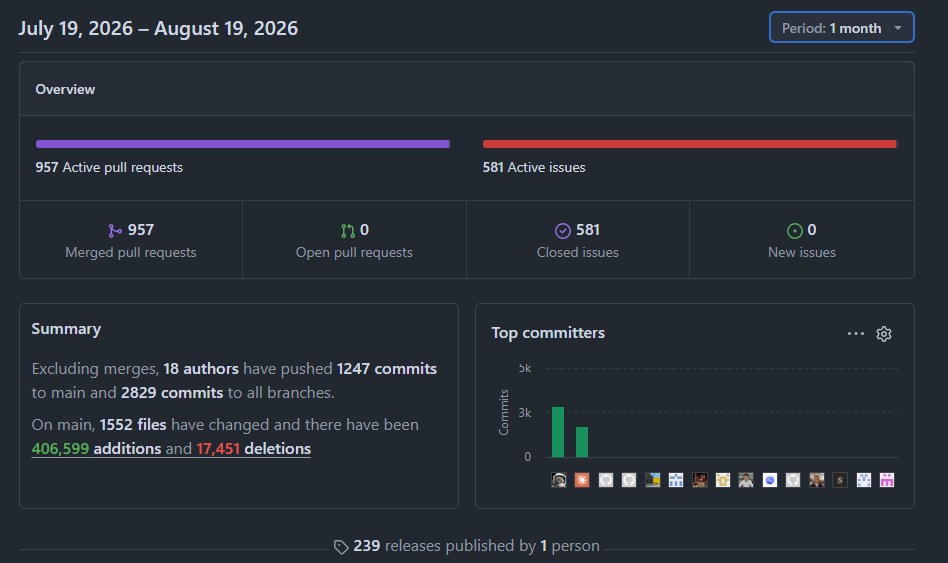 **957 pull requests merged. Zero open. 581 issues closed. Zero new.**
The zeros are the interesting part, and they do *not* mean "no bugs". They mean nothing is sitting
in limbo. That is the terminal-state rule from stage 3 showing up as a statistic: every issue lands
in MERGED, CLOSED-NO-CODE or PARKED, and a swarm that is not allowed to leave things half-finished
produces an empty queue as a side effect. A backlog is what accumulates when work can stop
somewhere other than a terminal state.
Two more from that panel, read carefully:
* **2,829 commits across all branches, but 1,247 on main.** The gap is not lost work. Main
squash-merges — 130 of its last 200 commits end in `(#N)` — so a PR that took three gate rounds
arrives as one commit. The branch total is where the rework lives: round two, round three, and
the fixes for the fixes.
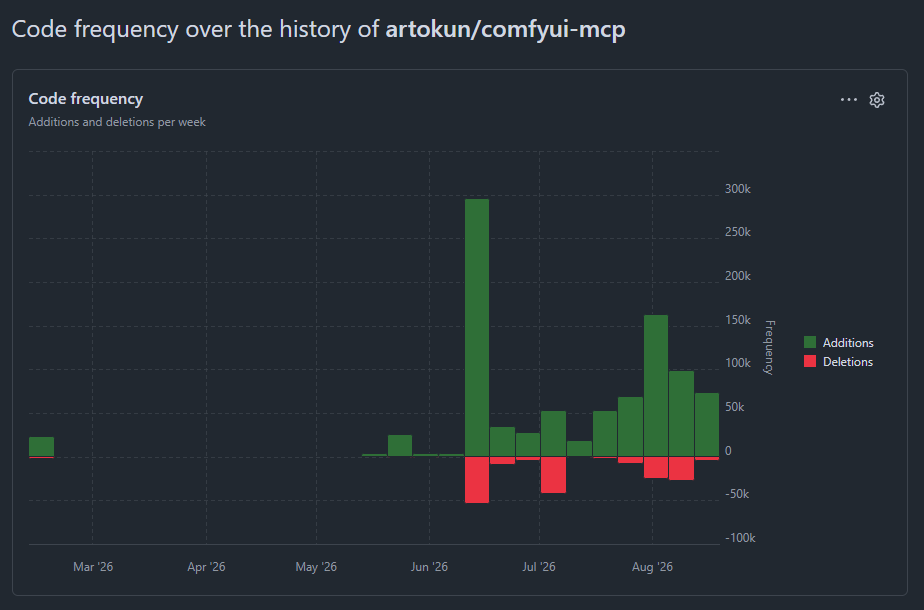
* **406,599 additions against 17,451 deletions**, a 23:1 ratio that would be alarming in a product
codebase. It mostly isn't product code. The docs ship in **11 translated locales**, and
translations are **71% of all documentation lines** — so a single docs change lands twelve times.
**957 pull requests merged. Zero open. 581 issues closed. Zero new.**
The zeros are the interesting part, and they do *not* mean "no bugs". They mean nothing is sitting
in limbo. That is the terminal-state rule from stage 3 showing up as a statistic: every issue lands
in MERGED, CLOSED-NO-CODE or PARKED, and a swarm that is not allowed to leave things half-finished
produces an empty queue as a side effect. A backlog is what accumulates when work can stop
somewhere other than a terminal state.
Two more from that panel, read carefully:
* **2,829 commits across all branches, but 1,247 on main.** The gap is not lost work. Main
squash-merges — 130 of its last 200 commits end in `(#N)` — so a PR that took three gate rounds
arrives as one commit. The branch total is where the rework lives: round two, round three, and
the fixes for the fixes.
* **406,599 additions against 17,451 deletions**, a 23:1 ratio that would be alarming in a product
codebase. It mostly isn't product code. The docs ship in **11 translated locales**, and
translations are **71% of all documentation lines** — so a single docs change lands twelve times.
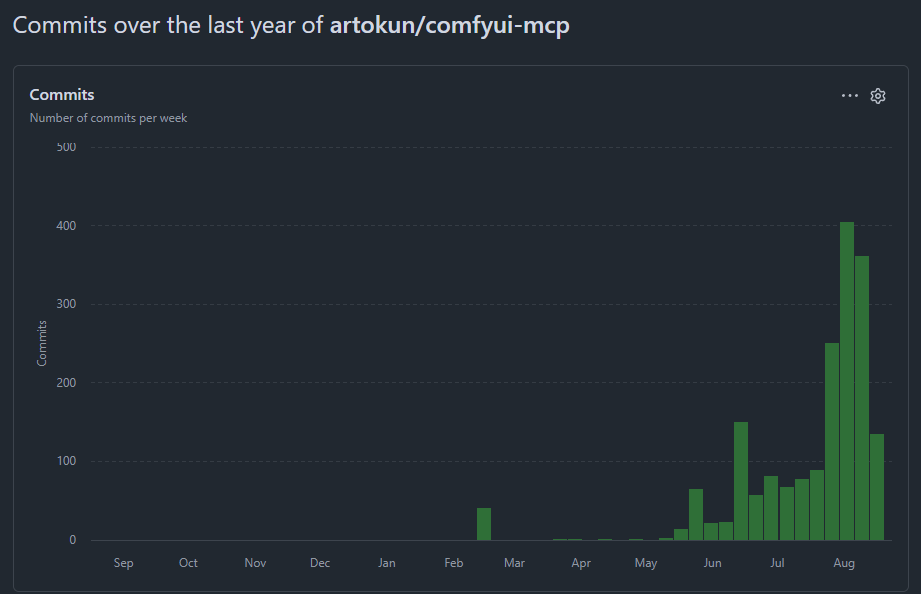
 The weekly commit chart goes from roughly flat to 400-a-week over one summer. That shape is what
this whole post is about — but it is a measure of *activity*, not of value, and it would look
identical if the swarm spent August writing elaborate nonsense. Which is precisely why the gate,
the mutation checks and the live verification exist: they are the part of the system that has an
opinion about whether any of those commits should have happened.
## An honest footnote about our download numbers
npm currently reports about **123,000 weekly downloads**, on a curve that bends up and to the right
in a way that would look excellent on a slide. Before anyone gets excited, here is the mechanism
behind the graph:
* The pipeline published **11 versions on the day this post was written** — and 11 more on a single
day the week before. There are 327 in total.
* Every install runs a self-updater that checks npm hourly
(`[self-restart] npx install — checking npm for updates every 60m`). So a release doesn't trickle
out over a week; the entire fleet pulls it at roughly the same moment.
* A gratifying number of MCP directories, mirrors and aggregators track our version and re-fetch
whenever it changes, which — see the first bullet — is frequently.
So a healthy slice of that curve is our own release cadence, multiplied by our own auto-updater,
admiring itself in a mirror. The counter is measuring how often the swarm has a productive
afternoon, not how many humans showed up. We're leaving it on the dashboard anyway.
The same discount applies to everything else GitHub reports:
The weekly commit chart goes from roughly flat to 400-a-week over one summer. That shape is what
this whole post is about — but it is a measure of *activity*, not of value, and it would look
identical if the swarm spent August writing elaborate nonsense. Which is precisely why the gate,
the mutation checks and the live verification exist: they are the part of the system that has an
opinion about whether any of those commits should have happened.
## An honest footnote about our download numbers
npm currently reports about **123,000 weekly downloads**, on a curve that bends up and to the right
in a way that would look excellent on a slide. Before anyone gets excited, here is the mechanism
behind the graph:
* The pipeline published **11 versions on the day this post was written** — and 11 more on a single
day the week before. There are 327 in total.
* Every install runs a self-updater that checks npm hourly
(`[self-restart] npx install — checking npm for updates every 60m`). So a release doesn't trickle
out over a week; the entire fleet pulls it at roughly the same moment.
* A gratifying number of MCP directories, mirrors and aggregators track our version and re-fetch
whenever it changes, which — see the first bullet — is frequently.
So a healthy slice of that curve is our own release cadence, multiplied by our own auto-updater,
admiring itself in a mirror. The counter is measuring how often the swarm has a productive
afternoon, not how many humans showed up. We're leaving it on the dashboard anyway.
The same discount applies to everything else GitHub reports:
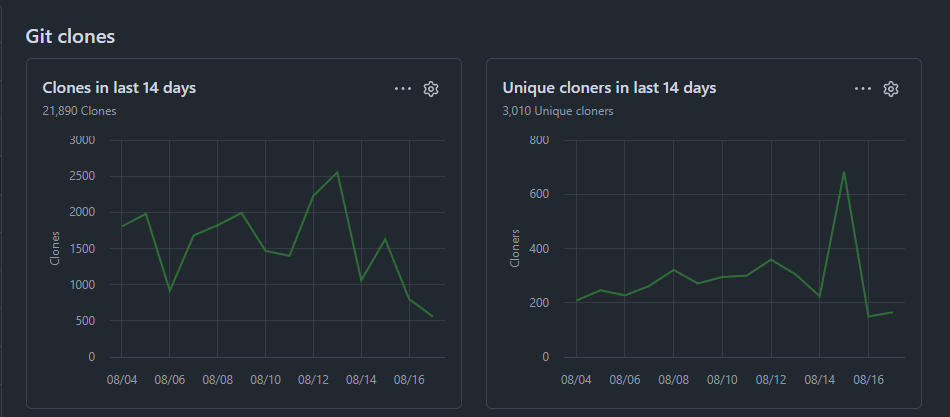
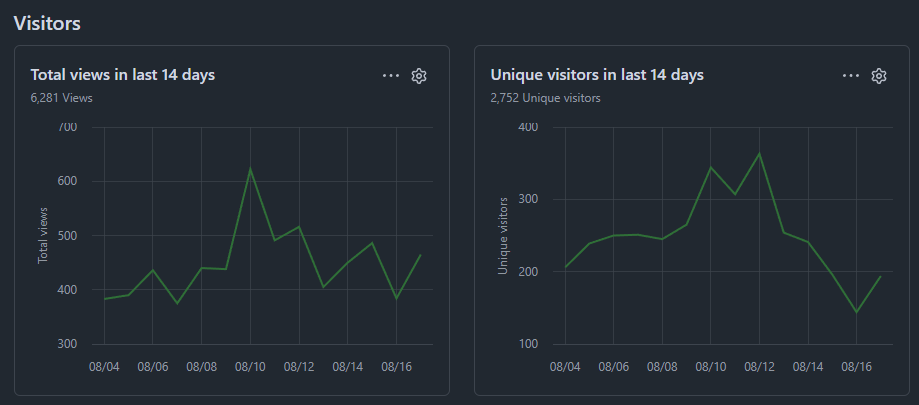 21,890 clones in two weeks from 3,010 unique cloners — and CI runners, mirrors and package
aggregators clone too. 6,281 views from 2,752 unique visitors is the more human-shaped number,
and the referrer table is the genuinely interesting one:
21,890 clones in two weeks from 3,010 unique cloners — and CI runners, mirrors and package
aggregators clone too. 6,281 views from 2,752 unique visitors is the more human-shaped number,
and the referrer table is the genuinely interesting one:
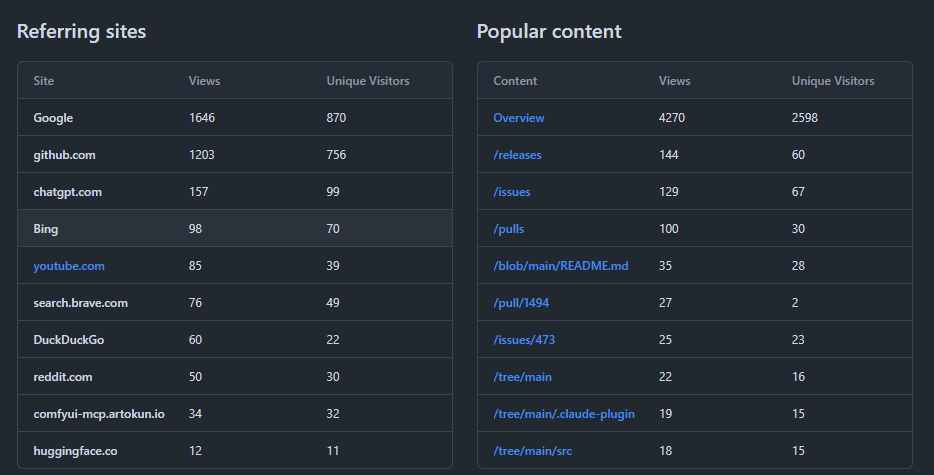 Search, then GitHub itself, then **chatgpt.com** ahead of Bing, Brave, DuckDuckGo and Reddit.
People are asking a model how to drive ComfyUI with an agent and arriving here on its
recommendation. For a project whose entire premise is agents using tools, being *discovered* by an
agent is a pleasing kind of circular.
## The numbers I don't have
Every figure above is collected by someone else — GitHub, npm — because the software itself
collects nothing. There is no Google Analytics on the docs, no telemetry in the panel, no
phone-home in the MCP server. Not one analytics SDK in either repository.
That is a deliberate choice, and an ambivalent one. I would genuinely like to know which panel
features get used and where people give up. But doing that properly under GDPR is real work for a
project this size, doing it improperly is worse than not doing it, and — honestly — the curiosity
isn't strong enough to outweigh either. So the instrumentation stays out.
Which is the actual reason this section is full of caveats. When you refuse to measure your users,
the only numbers left are proxies someone else happened to collect for a different purpose. Bad
proxies, cheerfully reported, beat good telemetry nobody consented to.
## Distribution is king
Three times now, someone has offered to pay to put an advertisement or their product inside the
panel. There are no ads in the panel, and none of those offers were taken.
That isn't a purity stance, and it's worth being precise rather than striking a pose. The sidebar
may well promote something one day — but our own adjacent tooling, not a stranger's. An
orchestrator that already drives ComfyUI has obvious neighbours: Blender, Unity, Unreal, each with
a plugin that could talk to the same agent. A panel that points at those is a different
proposition from renting the sidebar out. The distinction that matters is who the surface serves —
the person using it, or whoever paid for the slot.
But the offers say something the graphs don't. Nobody made those offers because of the code
quality, the test count, or the gate rounds this post spends most of its length on. They made them
because the thing is *installed* — sitting in a sidebar, opening every time someone launches
ComfyUI. Distribution is the asset. Everything upstream of it — the triage worker, the swarm, the
adversarial review — exists to make sure that what gets distributed, at eleven releases a day into
an auto-updating fleet, is worth having there.
That cuts both ways, and it is the strongest argument for the paranoia. A pipeline this fast with a
weaker gate would not be an achievement; it would be a very efficient way to push a bug to every
install on the same afternoon.
## The economics: intake is free, fixing isn't
The unusual property of this pipeline is that **the reports cost us nothing to produce.** They are
written by the user's own agent, running on the user's machine, spending the user's tokens, at the
moment the defect happened. Nobody staffs a support inbox. Nobody translates a screenshot into a
reproduction.
And the reports are better than the ones a human would file, for a reason that has nothing to do
with the model being clever: the reporter was *present at the crime*. It has the stack trace, the
exact tool call, the version of everything, and — under the fix-then-file rule — often a working
patch it already applied to unblock the user. A human filing the same bug three hours later has
none of that and is reconstructing from memory.
**Fixing is where the money goes.** Agent time, gate rounds, re-runs, and the tokens behind all of
them. That asymmetry is the whole design: make intake free and abundant so nothing goes unreported,
then spend the real budget on the part that requires judgement.
### Why this is hard to copy
It is not a clever trick, and I don't think it generalises easily. It needs two things at once, and
most products have neither:
1. **An agent already running on the user's machine**, with enough access to see what actually
happened. Telemetry can't do this — telemetry gives you counters and a stack trace at best, not
a diagnosis.
2. **That agent instructed to report**, with a tool to do it and a bias toward filing. The
instruction is the load-bearing half. An agent that *can* file bugs but is never told that a
workaround it invented is itself a signal will simply route around every defect silently, and
you will never hear about any of it.
If you ship an agentic product that runs locally, you are already sitting on this and probably not
using it. If you ship a hosted service, you can't do it at all.
### The honest bound on turnaround
Reports usually reach a terminal state inside a day. That is a description, not a service level
agreement, and the constraint is not technical: this is unpaid work that runs on whatever capacity
is left over from paid client work — implementing AI generative workflows for large consumer and
enterprise brands ([LinkedIn](https://www.linkedin.com/in/alongbottom/), if you want the specifics).
Some weeks that leftover is generous and the queue empties overnight. Some weeks it isn't. The
pipeline is what makes a spare evening productive enough to clear a day's reports — but nobody
should read "same-day fix" as a promise, and I would rather say so than let the graphs imply an
availability that isn't being sold.
## The attack this design invites
Everything above should worry you a little, and it is better said out loud than discovered by a
reader.
This pipeline accepts untrusted text from strangers, hands it to an agent that writes code, and
publishes the result to a fleet that auto-updates hourly. Written that plainly, it is a
**prompt-injection supply-chain attack** waiting for someone patient. The shape is not exotic:
```mermaid theme={null}
flowchart LR
A["Crafted report
Search, then GitHub itself, then **chatgpt.com** ahead of Bing, Brave, DuckDuckGo and Reddit.
People are asking a model how to drive ComfyUI with an agent and arriving here on its
recommendation. For a project whose entire premise is agents using tools, being *discovered* by an
agent is a pleasing kind of circular.
## The numbers I don't have
Every figure above is collected by someone else — GitHub, npm — because the software itself
collects nothing. There is no Google Analytics on the docs, no telemetry in the panel, no
phone-home in the MCP server. Not one analytics SDK in either repository.
That is a deliberate choice, and an ambivalent one. I would genuinely like to know which panel
features get used and where people give up. But doing that properly under GDPR is real work for a
project this size, doing it improperly is worse than not doing it, and — honestly — the curiosity
isn't strong enough to outweigh either. So the instrumentation stays out.
Which is the actual reason this section is full of caveats. When you refuse to measure your users,
the only numbers left are proxies someone else happened to collect for a different purpose. Bad
proxies, cheerfully reported, beat good telemetry nobody consented to.
## Distribution is king
Three times now, someone has offered to pay to put an advertisement or their product inside the
panel. There are no ads in the panel, and none of those offers were taken.
That isn't a purity stance, and it's worth being precise rather than striking a pose. The sidebar
may well promote something one day — but our own adjacent tooling, not a stranger's. An
orchestrator that already drives ComfyUI has obvious neighbours: Blender, Unity, Unreal, each with
a plugin that could talk to the same agent. A panel that points at those is a different
proposition from renting the sidebar out. The distinction that matters is who the surface serves —
the person using it, or whoever paid for the slot.
But the offers say something the graphs don't. Nobody made those offers because of the code
quality, the test count, or the gate rounds this post spends most of its length on. They made them
because the thing is *installed* — sitting in a sidebar, opening every time someone launches
ComfyUI. Distribution is the asset. Everything upstream of it — the triage worker, the swarm, the
adversarial review — exists to make sure that what gets distributed, at eleven releases a day into
an auto-updating fleet, is worth having there.
That cuts both ways, and it is the strongest argument for the paranoia. A pipeline this fast with a
weaker gate would not be an achievement; it would be a very efficient way to push a bug to every
install on the same afternoon.
## The economics: intake is free, fixing isn't
The unusual property of this pipeline is that **the reports cost us nothing to produce.** They are
written by the user's own agent, running on the user's machine, spending the user's tokens, at the
moment the defect happened. Nobody staffs a support inbox. Nobody translates a screenshot into a
reproduction.
And the reports are better than the ones a human would file, for a reason that has nothing to do
with the model being clever: the reporter was *present at the crime*. It has the stack trace, the
exact tool call, the version of everything, and — under the fix-then-file rule — often a working
patch it already applied to unblock the user. A human filing the same bug three hours later has
none of that and is reconstructing from memory.
**Fixing is where the money goes.** Agent time, gate rounds, re-runs, and the tokens behind all of
them. That asymmetry is the whole design: make intake free and abundant so nothing goes unreported,
then spend the real budget on the part that requires judgement.
### Why this is hard to copy
It is not a clever trick, and I don't think it generalises easily. It needs two things at once, and
most products have neither:
1. **An agent already running on the user's machine**, with enough access to see what actually
happened. Telemetry can't do this — telemetry gives you counters and a stack trace at best, not
a diagnosis.
2. **That agent instructed to report**, with a tool to do it and a bias toward filing. The
instruction is the load-bearing half. An agent that *can* file bugs but is never told that a
workaround it invented is itself a signal will simply route around every defect silently, and
you will never hear about any of it.
If you ship an agentic product that runs locally, you are already sitting on this and probably not
using it. If you ship a hosted service, you can't do it at all.
### The honest bound on turnaround
Reports usually reach a terminal state inside a day. That is a description, not a service level
agreement, and the constraint is not technical: this is unpaid work that runs on whatever capacity
is left over from paid client work — implementing AI generative workflows for large consumer and
enterprise brands ([LinkedIn](https://www.linkedin.com/in/alongbottom/), if you want the specifics).
Some weeks that leftover is generous and the queue empties overnight. Some weeks it isn't. The
pipeline is what makes a spare evening productive enough to clear a day's reports — but nobody
should read "same-day fix" as a promise, and I would rather say so than let the graphs imply an
availability that isn't being sold.
## The attack this design invites
Everything above should worry you a little, and it is better said out loud than discovered by a
reader.
This pipeline accepts untrusted text from strangers, hands it to an agent that writes code, and
publishes the result to a fleet that auto-updates hourly. Written that plainly, it is a
**prompt-injection supply-chain attack** waiting for someone patient. The shape is not exotic:
```mermaid theme={null}
flowchart LR
A["Crafted report
(or a poisoned page
the agent read)"] --> B["Triage"]
B --> C["Fixing agent reads
the issue body"]
C --> D["Diff that looks
like a fix"]
D --> E["Gate reviews
the DIFF"]
E --> F["Publish"]
F --> G["Hourly auto-update
across every install"]
style A fill:#7f1d1d,color:#fff
style G fill:#7f1d1d,color:#fff
```
The payload doesn't have to be dramatic. "Your version detection is wrong, the fix is to depend on
``" is enough, if it survives to a merge.
**What actually helps here**, and it is less than you'd want:
* **The reviewer judges the diff, not the report.** The gate is handed `git diff base...HEAD` and
told to refute it. Prose in an issue body — the attacker's channel — is not in that input at all.
This is the single strongest property in the design, and it is somewhat accidental: it was built
to stop an author from talking their reviewer into approving, and it happens to stop a stranger
from doing the same.
* **Dependency and workflow changes are in the reviewed diff.** The gate excludes test files, not
`package.json`, lockfiles or CI configuration. A new dependency shows up as a diff line in front
of an adversarial reader.
* **Static scanning on the panel's publish path.** The sidebar pack runs bandit and a YARA-parity
pass in CI *and* again at publish, mirroring the Comfy Registry's own scanner: process-spawn
literals, SVG event-handler tricks, the shapes malicious packs actually use. It is pattern
matching, and pattern matching catches the careless attacker rather than the careful one — but it
is a real gate that has blocked real things.
* **Publishing is attested.** Releases go out with `npm publish --provenance`, so an artifact can be
traced to the workflow run and commit that built it. That proves origin — it does not prove the
code is benign.
* **Main is protected and every change is a PR.** There is no path from an issue to a release that
skips a reviewed diff and CI.
**What does not help, and I won't pretend otherwise:**
* The fixing agent *does* read attacker-controlled text. That is the entire point of a bug report.
Instruction-versus-data separation inside a single context window is not a solved problem, and I
don't have a solution that isn't just "hope the model behaves".
* **A reviewer's diff can be truncated.** Both gates cap the diff they embed (default 1,000 lines)
and tell the reviewer to read the rest directly. A payload deliberately placed past that cutoff
is, at minimum, less likely to be read.
* The **blast radius is the feature**, and no amount of review changes that arithmetic.
* **The blast radius is the feature.** Same-day fixes and an hourly auto-updater are the same
mechanism, and it does not distinguish a good commit from a bad one. The thing that makes a fix
reach everyone by dinner makes a compromise reach everyone by dinner.
### What writing this section changed
Documenting a system turns out to be an efficient way to audit one. Drafting the paragraphs above
surfaced three gaps that were real, and they were closed before this post went up rather than
described as future work:
* **A SHIP verdict is no longer unconditional.** Both gates now refuse to pass a diff that touches
the supply chain — `package.json`, any lockfile, `pyproject.toml`, anything under `.github/`, or
the publish scripts — unless a human explicitly acknowledges it. Those paths were previously
reviewed exactly as carefully as a comment fix.
* **A truncated diff no longer counts as a reviewed one.** Both gates cap the diff they embed. A
pass over a diff we *know* was clipped now downgrades to the hold state, because "the reviewer
was told to go read the rest itself" is not evidence that it did.
* **Dependency advisories are now tracked.** Neither repository had Dependabot, CodeQL or an
`npm audit` step. The existing scans look for malicious patterns in *our own* code; nothing was
watching for an advisory filed against something we already depend on. Both repos now run weekly
grouped updates across every ecosystem that reaches a user — including GitHub Actions, since a
compromised action runs with the credentials of the one job here that can publish.
Bumps are also explicitly out of scope for the swarm, and that needed enforcing rather than
assuming. The finisher extracts an issue number from a PR's body, falling back to digits in the
branch name — and a dependency bump quoting an upstream `#1524` in its changelog resolves to a real
issue number in this repo. It now skips bot-authored PRs outright, because the author field is the
one thing a crafted body cannot spoof.
What remains unfixed is the hardest one: the fixing agent still reads attacker-controlled text,
because that is what a bug report *is*. Separating instruction from data inside one context window
is not a solved problem, and I'd rather name the residual risk than imply a guarantee I can't back.
If you are building something similar, inherit the paranoia along with the pipeline — the autonomy
is the easy part.
## Why an independent project builds this at all
comfyui-mcp shipped its first npm version on **15 February 2026**. The official `comfy-mcp` package
was first published on **31 July 2026** — five and a half months later. You can check both with
`npm view time.created`; I'd rather cite something verifiable than claim a head start.
That gap is the whole context for this post. An independent project that arrives first does not get
to compete on domain authority, a marketing budget, or a place in the official docs. There has been
no ad spend here — not as a strategy, just as a fact; the traffic in the section above is search
results, GitHub, and people telling each other. That advantage is not durable and I don't pretend
otherwise: authority accrues to whoever owns the domain, eventually.
What an independent project *can* compete on is the thing this whole post describes. Nobody with a
larger budget is going to out-care you about whether a Windows account with a locked-down Task
Scheduler can start a background process. The pipeline is the answer to being outgunned everywhere
else: if the fix for the bug you filed can be triaged, written, adversarially reviewed, verified on
real hardware and published while you are still reading the issue thread, that is a form of
competition that headcount doesn't straightforwardly beat.
None of this is paid work. It exists because people use it and it helps them, and because a bug
report answered by a shipped release the same day is a genuinely satisfying thing to build. The
metrics section above is careful about what it can and cannot claim. This part isn't a metric at
all — it's just the reason the rest of it gets maintained.
## What this does not do
It does not remove judgement; it relocates it. A human still decides what is in scope, what is
parked, and when a "fix" is really a product decision. The pipeline's job is narrower: make sure
nothing is silently dropped, nothing merges unreviewed, and nothing ships unverified.
And it fails in instructive ways. The same day this post describes, a fix merged while its gate was
still running — landing three P1s in a published release that the gate had already found. The
pipeline was right; the sequencing wasn't. The gate is only a gate if you wait for it.
## "This is just AI slop"
Someone is going to say that, so let's take it seriously rather than get defensive about it.
The literal claim is true and there's no point pretending otherwise: this code is largely written by
agents. Vibe-coded, if you like. Conceded — including the parts of this post you're reading.
But "slop" isn't really a claim about *authorship*, it's a claim about *attention*. The failure mode
people have in mind is generated code that nobody checked: plausible-looking, superficially
reviewed, accumulating in a codebase until it can't be reasoned about. That is a real thing and it
happens constantly. The interesting question isn't whether a model wrote the diff. It's what the
diff had to survive.
Here's what it has to survive, and the receipts are all in this post:
* A reviewer that **says no a lot.** Not a rubber stamp: on one small Windows fix, successive rounds
turned up six P1 defects across three rounds — and two of those were introduced by the fixes for
the previous round's
findings. The system's most-used output is "not yet".
* **Mutation checks**, because a passing test is not evidence. Break the fix; if the suite stays
green, the test was decoration. This routinely catches wiring that no test actually reaches.
* **Live verification** against real hardware, and for releases, against the *published tarball* —
not the CI run that produced it.
* **Terminal states**, so nothing is quietly abandoned. 957 PRs merged and zero left open is not a
boast about volume; it's the absence of a junk drawer.
* And the thing that produced this very post's security section: writing the system down caused
three real gaps to be found and closed before publication.
The fair version of the criticism still lands, though, and it's worth stating in its strongest form.
The gate is *also* an AI — models reviewing models, which is not the independent check a human
reviewer would be. What keeps it from being pure theatre is structural rather than magical: it's a
fresh session with no memory of having written the thing, handed only the diff, told to refute. And
empirically it refuses, often, on grounds the author had already convinced themselves were fine.
That is weaker than a good human reviewer. It is enormously stronger than nothing, which is the
actual alternative on a project with one unpaid maintainer.
The other fair hit: **volume is not virtue.** 406,599 additions in a month is a number the graphs
love and it proves nothing at all. A pipeline like this makes it trivially easy to produce more
code than anyone can hold in their head, and most of the machinery described above exists precisely
because that's dangerous, not because it's impressive.
So: slop, sure — but slop that scoops itself up. Left unattended it leaks everywhere; that's the
whole reason for the gate, the mutations, the terminal states and the paranoia about the publish
path. Tidiness here isn't a personality trait, it's a build step. And when it slips — when a merge
beats its own gate and three P1s reach a release — you get to read about that too, four paragraphs
up, in the same post.